ATOME Villeta
Building Latin America’s first industrial-scale low-carbon fertiliser plant, ATOME Villeta will use Paraguay’s hydropower to produce green CAN fertiliser with a 10-year Yara offtake.
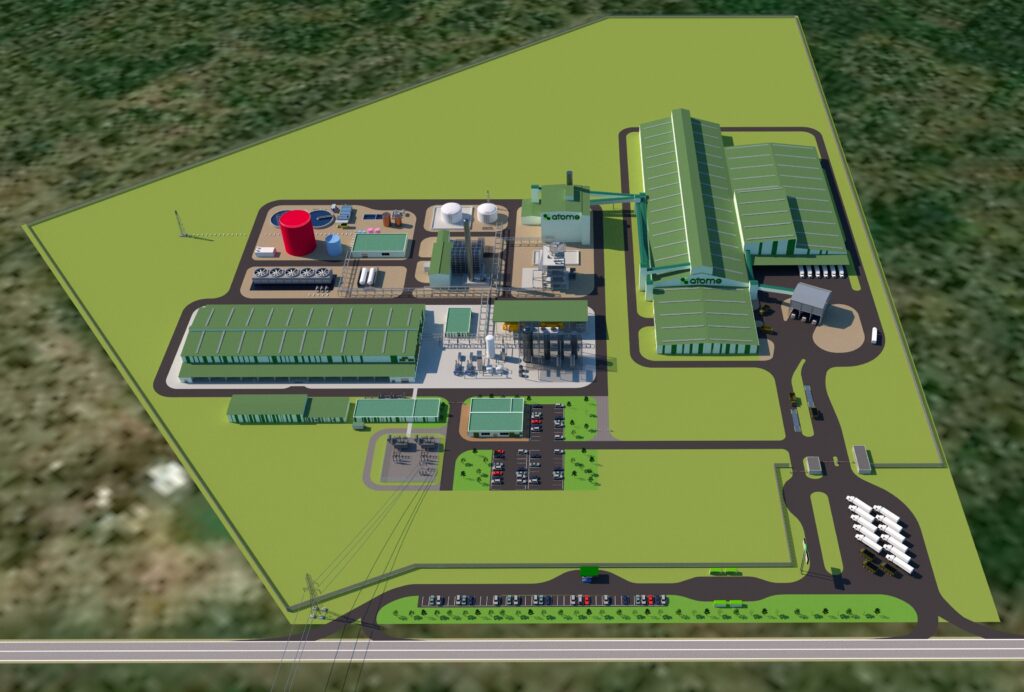
ATOME is charting a new course for fertiliser production in Latin America. Its flagship Villeta Project in Paraguay will harness the country’s abundant hydropower to produce low-carbon Calcium Ammonium Nitrate (CAN) fertiliser, made using green ammonia, on an industrial scale.
With a binding offtake agreement secured with Yara for the entire production at Villeta and financing almost in place, the project is approaching FID and poised to become a cornerstone of sustainable agriculture, whilst presenting a replicable model for decarbonisation across the region.
| KEY FACTS | |
|---|---|
| Official project name | ATOME Villeta |
| Parent company | ATOME PLC, AIM listed company with shareholders including Schroders and Baker Hughes |
| Location | Villeta, Paraguay |
| Project stage | Progressing towards FID |
| Sector | Chemicals, ammonia |
| Total project investment | $630 million, Hy24 anchor lead equity investor |
| Customers | 100% minimum 10-year offtake agreement with Yara, the world’s leading crop nutrition, production and distribution company of fertiliser products |
| Jobs | Significant local employment in construction and operations |
| Capacity | 260,000 tonnes per annum (tpa) of CAN fertiliser via a 145MW renewable power purchase agreement and a 30-hectare site |
| Key milestones | • Project announced in May 2022 • Binding 145MW PPA announced July 2023 • FEED completed June 2024 • Terms agreed with Hy24 as anchor equity investor in February 2025 • EPC contract signed with Casale SA April 2025 • Definitive offtake agreement signed with Yara in September 2025 • Concessional financing approved by the board of GCF, the world’s largest climate fund in July 2025 • FID and start of construction expected Q4 2025 • Commissioning expected end 2028 |
Project and Company Vision
The Villeta project is ATOME’s flagship initiative to produce green fertiliser using renewable electricity. It is designed to shield regional economies from global supply shocks by reducing reliance and targeting price parity with imported fertilisers, and create high-quality jobs. For ATOME, the project is about more than being aligned to climate targets – it represents the opportunity to anchor Paraguay within an emerging global green value chain, producing a sustainable and cost-effective product for both domestic and regional markets.
At the start of the Ukraine war, we saw the price of chemicals go through the roof. Many agri-focused economies were severely hurt and for example, Brazil had a fair share of bankruptcies because of the price of fertilisers.
— Olivier Mussat
CEO of ATOME
Finding the right product and market
ATOME deliberately chose CAN fertiliser for its premium market positioning over the highly cost-sensitive urea market. As a nitrate product with superior agronomic properties, CAN appeals to a range of buyers with ambitions for both sustainability and farming efficiency, such as global food companies like PepsiCo – who understand the value of a green premium. This strategic decision ensures the Villeta project meets both corporate sustainability objectives and growing market demand.
Latin America is a prime region because it imports more than 90% of all its nitrogen fertiliser supply and pays more for it than in Europe. Paraguay has a large agricultural export-based economy, but its first export is power. It is the country’s strategic aim to use this national natural resource to create a new green economic sector, positioning the country as a climate leader whilst strengthening and diversifying its economy.
— Olivier Mussat
CEO of ATOME
Securing offtake and financing
The offtake agreement with Yara, one of the world’s leading fertiliser producers, was a turning point. By locking in 100% of output for a minimum of 10 years, ATOME de-risked the project for lenders and demonstrated commercial viability. Proposals from Development Finance Institutions including from the Inter-American Development Bank (IDB), International Finance Corporation (IFC), FMO, the Dutch development bank, the European Investment Bank, as well as concessional finance from the Green Climate Fund, helped strengthen the debt structure. For project equity, ATOME already announced agreed terms with Hy24, the world’s largest low-carbon hydrogen asset manager, as its anchor and lead project equity investor.
The reality is that the green market is growing but no debt financier will give you credit for something that does not yet exist at scale (the green premium) and that includes DFIs and lenders with a stated green agenda, so you have to show that you can be competitive with the grey market [and not be a collector of subsidies or requiring difficult-to-justify green premiums]
Offtake is the number one derisking angle and always has been in infrastructure finance. The Villeta project straddles infrastructure and chemicals, and there was a lot of education to be done to lenders and investors
— Olivier Mussat
CEO of ATOME
Building the right team
From inception, ATOME assembled a team with deep expertise in emerging markets, infrastructure finance, public and private equity, agriculture and industrial operations. Local leadership in Paraguay has been instrumental in navigating regulatory processes and securing stakeholder support for this first of a kind project. Early backing from the IDB enabled early completion of environmental and social impact assessments, giving the project credibility and advanced sight of risks.
Regional Impact and Strategic Importance
The facility’s location near to the Paraguay River enables efficient logistics across Mercosur, including western Brazil, northern Argentina, and Uruguay. It also provides a direct export route to Europe, linking Latin American agricultural products with evolving sustainability standards in consumer markets. For Paraguay the project shows a path to industrial diversification, food and energy security and a stronger role in regional trade. Seeing the potential socio-economic benefits that the US$630 million project could bring to the region, the Paraguay government granted Villeta Free Trade Zone status.
Lessons Learned and Scalable Strategies
The Villeta project is designed as a replicable model for decentralised green fertiliser production. By starting with a manageable scale and de-risking every aspect, from technology to market, ATOME aims to build credibility and expand across the region. Future projects may take on more risk, but will benefit from the blueprint established in Villeta. Several key lessons emerge from ATOME’s experience:
- Offtake is the cornerstone of project finance: Securing long-term buyers is essential to unlocking investment.
- Knowing how to negotiate and build projects: selecting the right engineering partners, putting together bankable EPC contracts and securing permitting early.
- Timing and resilience are important: Infrastructure projects inevitably face delays. Macroeconomic conditions, commodity cycles and shifting ESG sentiment can have a dramatic impact on financing; projects must be structured to ride out the storm and compete with incumbent grey markets.
- Strong leadership enhances resilience: Villeta demonstrates the value of combining international expertise with strong local leadership. Navigating financial cycles, regulatory barriers, environmental and social commitment and stakeholder management requires a team able to adapt quickly and maintain investor confidence amid changing conditions.
- Educating the supply chain is critical: From financiers to off-takers, every stakeholder needs to understand the project’s value proposition. While farmers in certain markets may face higher initial costs, the impact on consumers is minimal, and communicating this clearly will help build support.
Looking ahead
The ATOME Villeta Project is emerging at a time when global fertiliser markets are undergoing significant transformation. With increasing scrutiny on the carbon footprint of agricultural inputs, low-carbon fertilisers are gaining traction amongst buyers seeking to secure their supply chains and align with sustainability goals. The Villeta plant, producing CAN-27 fertiliser using low-cost baseload hydropower, positions Paraguay as a pioneer in this transition and demonstrates ATOME’s ability to generate projects providing low-carbon solutions in proximity to existing demand centres.
With its strategic location at the heart of Mercosur, strong partnerships, and a pragmatic approach, Villeta is set to become a landmark project in low-carbon fertiliser with significant local and global benefits. As it approaches FID, the project could be a blueprint for replicable, decentralised low-carbon fertiliser production models across emerging markets.