European Energy | Kassø
Kassø, in southern Denmark, is now home to one of the world’s first operational e-methanol facilities, producing 42,000 tonnes per year from a 304 MW solar park, a 52 MW electrolyser and biogenic CO₂ captured from a local biogas facility. It reached FID in January 2022 without operating subsidies and started operations in 2025.
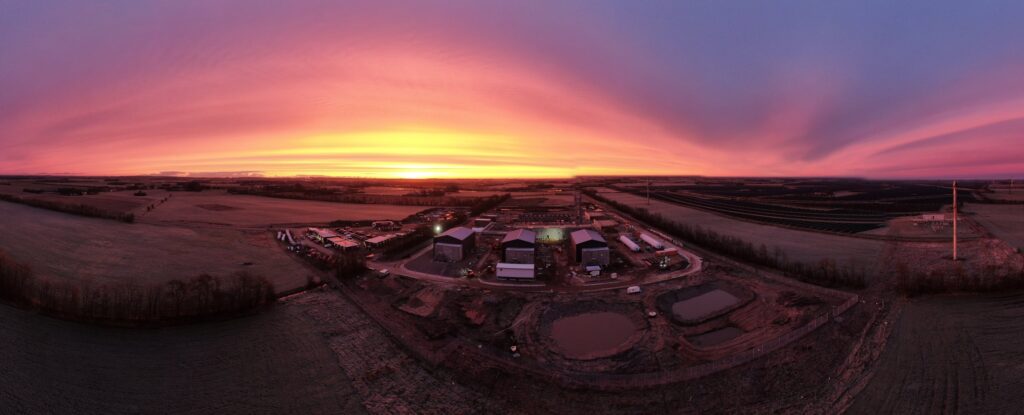
Kassø, in southern Denmark, is now home to one of the world’s first operational e-methanol facilities, producing 42,000 tonnes per year from a 304 MW solar park, a 52 MW electrolyser and biogenic CO₂ captured from a local biogas facility. It reached FID in January 2022 without operating subsidies and started operations in 2025.
| KEY FACTS | |
|---|---|
| Official project name | Kassø |
| Location | Southern Denmark |
| Project stage | Operational |
| Sector | e-methanol |
| Capacity | 42,000 tonnes per year |
| Customer | Maersk anchor offtaker |
| Key milestones | • 2021 – Anchor offtake secured: Maersk signed the first offtake agreement. • January 2022 – Final Investment Decision (FID). • 2023 – Offtake base widened: LEGO and Novo Nordisk signed on to use e-methanol in their plastics supply chains, diversifying demand beyond shipping into chemicals and consumer goods. • 2025 – Start of operations: The plant began producing 42,000 tonnes/year of e-methanol from a 304 MW solar park, 52 MW electrolyser, and biogenic CO2. |
| Owner / developer | European Energy |
European Energy is a private renewable energy developer spanning origination, construction and asset management. Recognising that direct electrification cannot reach every energy-intensive sector, it set out to convert its renewable power into low-carbon molecules, turning electrons into fuels and feedstocks for shipping, chemicals and consumer goods.
Kassø, in southern Denmark, is now home to one of the world’s first operational e-methanol facilities, producing 42,000 tonnes per year from a 304 MW solar park, a 52 MW electrolyser and biogenic CO₂ captured from a local biogas facility. It reached FID in January 2022 without operating subsidies and started operations in 2025.

Offtake as the foundation
Bankability was key to unlocking the project. In 2021, Maersk signed the anchor offtake agreement, contributing to minimize the first-mover risk and demonstrating that shipping could shift from spot contracts to long term commitments. LEGO and Novo Nordisk followed in 2023, using e-methanol to replace fossil methanol in their plastics supply chains. These three distinct markets provided revenue certainty, reducing financial risk and validating the product.
Owning the value chain
The Kassø site was built largely from scratch, with European Energy retaining control wherever possible. It supplies its own renewable power, developed its methanol synthesis technology and secured CO₂ supply from one of the biggest biogas plants in Denmark and secured the CO2 technology through the acquisition of Ammongas, a biogas upgrading and CO₂ capture specialized company. Siemens supplied electrolysers, Schneider Electric integrated the system and Mitsui & Co., which holds a 49% stake, added methanol market expertise and commercial confidence.
This integration proved decisive: For a first-of-a-kind project with multiple technologies, technical issues could be resolved across desks rather than across contracts – accelerating problem-solving and strengthening investors and offtaker confidence.
When you own the value chain, that’s very powerful, especially being a first mover. You can put the engineers together and solve a common problem. This is now being applied in the next suite of projects such as in Brazil, Spain, Australia and Denmark
— European Energy
“When you own the value chain, that’s very powerful, especially being a first mover. You can put the engineers together and solve a common problem. This is now being applied in the next suite of projects such as in Brazil, Spain, Australia and Denmark”
Jaime Casasus-Bribian, Head of PtX Projects (Americas, Iberia, Australia), European Energy, CEO Ammongas
Learnings
Permitting was a significant challenge with around 30 approvals needed rather than the anticipated five to seven, reflecting the plant’s novel hybrid nature. Operationally, power costs are the core challenge. Electricity accounts for more than half of production costs and managing production against volatile wholesale prices adds complexity. Grid connection delays also pushed back commissioning by a number of months. These lessons are now informing plans for a ~100 ktpa expansion at Kassø, where existing infrastructure, permits and operational data provide a material head start.
The business case for going first
“We are first movers and risk takers, but with a measured approach. Our expansion plan is three times the size of Kassø – big enough to be relevant, yet still manageable.” Jaime Casasus-Bribian, Head of PtX Projects (Americas, Iberia, Australia), European Energy, CEO Ammongas.
Kassø now serves as a blueprint being tested in Denmark, Brazil, Spain and Australia By moving early and operating at scale, European Energy has secured advantages later movers cannot buy: proven performance, real cost data and offtaker relationships.
| What is e-methanol? | Produced by synthesising green hydrogen – made via electrolysis using renewable electricity – with biogenic or captured CO₂. The result is chemically identical to fossil methanol but with a much lower carbon footprint. | Because methanol is already widely used in shipping and the chemicals sector, e-methanol can act as a near-drop-in replacement – making it one of the most practical early solutions for decarbonising energy-intensive sectors. |