OMV Petrom
OMV Petrom is building Romania’s first large-scale Sustainable Aviation Fuel facility at Petrobrazi refinery.
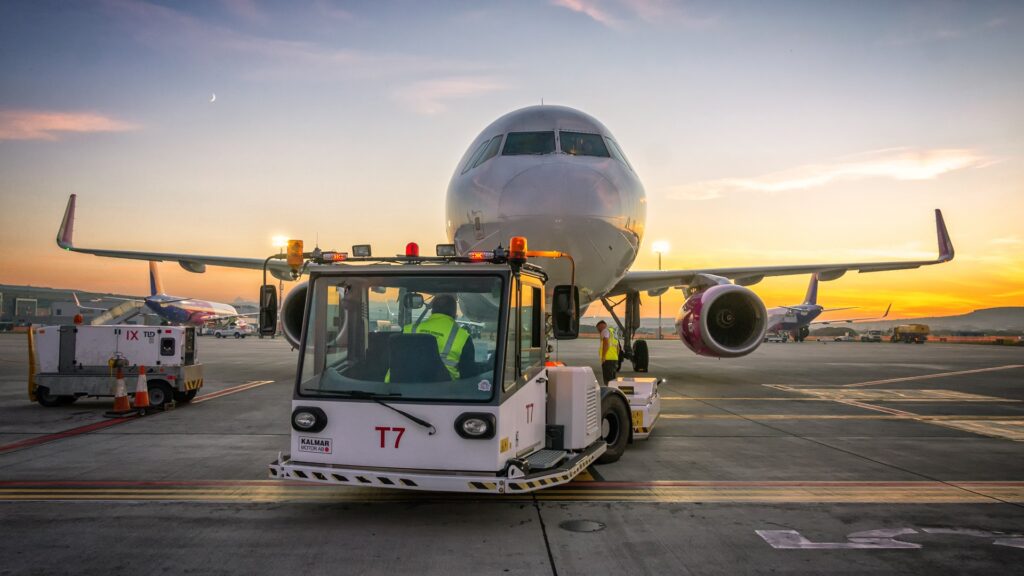
Building a regional hub for sustainable aviation fuels
OMV Petrom is positioning Romania at the forefront of aviation decarbonisation. At its Petrobrazi refinery, construction is underway on a new facility that will produce Sustainable Aviation Fuel (SAF) at commercial scale. By moving early, the company aims to secure a foothold in a market that is set to expand rapidly.
| KEY FACTS | |
|---|---|
| Official project name | Sustainable Aviation Fuel Unit |
| Location | Prahova County, Romania |
| Project stage | In construction (FID 2024, start construction 2025) |
| Sector | Aviation |
| Customer | Regional airlines; continuing collaboration with existing clients |
| Total Project investment | €750 million, including EU funding for 2 green hydrogen units |
| Jobs | ~10,000 employees at the end of 2024 |
| Capacity | 250,000 tonnes per year of biofuels (SAF and HVO – hydrotreated vegetable oil) |
Project and company vision
OMV Petrom, the largest integrated energy producer in South-Eastern Europe, has committed to developing a major sustainable aviation fuel (SAF) facility at its Petrobrazi refinery. The goal is to become the first mover in the region’s SAF market, offering a reliable supply to airlines that need to comply with EU decarbonisation targets.
The ambition aligns with the EU ReFuelEU Aviation mandate, which will require 70% of jet fuel to be SAF by 2050. Petrobrazi’s new capacity will position Romania to benefit from these new markets and demonstrates OMV Petrom’s broader energy transition strategy.
Support from the existing customers and an increasing European regulatory push for decarbonised aviation are accelerating this vision. OMV Petrom is not only responding to regulation, but also actively shaping a market that is still in its formative stage. The strategic question for OMV Petrom is how much SAF it can deliver before 2030, by which time airlines and airports must secure supply, to establish a strong regional foothold before the market tightens.
“OMV Petrom is actively developing sustainable fuel production to support the shift toward cleaner energy. This initiative plays a key role in reducing carbon emissions, particularly in hard-to-electrify sectors like aviation. It reflects our practical commitment to building a lower-carbon future through real, on-the-ground solutions.”
— David Zeilinger
Director of Strategic Programs and Projects
Implementation and partnerships
The project builds on Petrobrazi’s existing infrastructure, which reduces risks and costs compared to many first-of-a-kind (FOAK) developments.
Feedstock security is a focus. More than 80% of the required inputs, mainly used cooking and vegetable oils, for the first 8 years of production have already been secured. OMV Petrom is also piloting the use of more challenging waste-based materials to build in flexibility and ensure long-term supply.
The facility will integrate two electrolysers with a total capacity of 55MW, one of the region’s largest, to be powered by renewables in order to supply green hydrogen for refining processes. While proton exchange membrane (PEM) technology is still relatively new, the company has reduced risks by consulting partners and drawing on international case studies.
Partnerships have been critical from the start. Procurement has been spread across multiple suppliers to maintain competition, while engagement with regulators and technology providers has ensured alignment on standards and delivery.
Challenges
While the initiative is expected to create new opportunities for the company, the complexity of building a FOAK facility in the region has also highlighted significant hurdles:
- Market uncertainty: Long-term demand and customers’ willingness to pay a green premium remain unclear. While EU policy gives confidence that demand will grow, local markets are less mature.
- Scenario planning: Internal teams considered more than 400 scenarios to stress-test the business case, covering fuel price volatility, regulatory shifts, and demand changes.
- Technology integration: While each element – electrolysis, pretreatment plants, renewable energy supply – is proven separately, combining their operations at scale is untested and requires detailed design work and external expertise.
- Procurement: Drawing on multiple suppliers reduces reliance on individual companies, but increases supply chain complexity.
- Electrolyser risk: The 55 MW total electrolyser capacity is one of the largest in the region, so there was limited operational data available.
“OMV Petrom is actively developing sustainable fuel production to support the shift toward cleaner energy. This initiative plays a key role in reducing carbon emissions, particularly in hard-to-electrify sectors like aviation. It reflects our practical commitment to building a lower-carbon future through real, on-the-ground solutions.”
— David Zeilinger
Director of Strategic Programs and Projects
Lessons learnt:
Although construction of the facility only started in 2025, the planning process has already yielded a number of valuable insights.
- First-mover advantage requires boldness, but not recklessness: Early action on feedstock, using existing infrastructure and building local partnerships secures customers and policy alignment.
- Backward integration is critical: Control over pretreatment and feedstock supply provides resilience against volatility and enables the company to experiment with more advanced and unconventional waste inputs.
- Planning must be scenario-driven: Running hundreds of demand, price and regulatory scenarios enabled OMV Petrom to prepare for a volatile market landscape and ensure that investment decisions were robust against multiple potential futures.
- Partnerships accelerate knowledge transfer: Collaborating with engineering firms, technology providers and refineries across Europe helped to compensate for the limited operational data available on new technologies such as PEM electrolysers.
Unlocking a global opportunity
The Petrobrazi project goes beyond a single facility. It demonstrates how existing refinery infrastructure can support the integration of SAF production and creates a replicable model for others across Europe.
For Romania the project creates jobs and builds a new value chain, while positioning the country at the forefront of European aviation’s decarbonisation strategy. More broadly, it highlights how the region can lead in new industrial markets.
As one of the clean industrial plants that has secured financing this year, Petrobrazi underlines the opportunity of a clean industry transformation. If replicated, projects of this type could help European airlines meet their SAF mandates, strengthen energy security and unlock huge economic and industrial opportunities.